Living on a few lines
i.
On June 29, 1943, Etty Hillesum wrote:
‘I have noticed that in every situation, even the most difficult, man generates new organs that help him go on living.’ [1]
Is the body, then, an expression of the spirit? I follow Etty. I make a mark. I choose the pencil, the paper, the time. Texture matters. The hours of the night, too. At night my pencil is slower, quieter, as if waiting. The night is a charged place for me. There's the unexpected shadow, the vase of flowers like a shell, the cups with their funny pink hats. At night there's no precision, yet all the senses seem strained toward hope.
On my desk I have Etty’s diary. Her words, her presence, her attention. In 1941 Etty was a young Jewish woman living in Amsterdam. She read, she thought, she felt. She was searching for something firm within herself while, outside, the world was closing in.
She began writing in march of that same year, after meeting Julius Spiar, a German psychologist and psychotherapist, student of Carl Gustav Jung. The notebook was meant to bring order: to her desires, her fear, the voices crowding on her head. Paper, ink, a room, the daily act of returning to the page. Then the diary changed. It became an inner place, small and resilient. A space in which to look at violence without allowing it to take over everything. Etty needs a home, a refuge, words.
On October 20, 1941 Etty writes: ‘Sometimes I want to flee with everything I possess into a few words, seek refuge in them. But there are still no words to shelter me. That is the real problem. I am in search of a haven, yet i must first build it for myself, stone by stone. Everyone seeks a home, a refuge. And I am always in search of a few words.’ [2]
And again one year later: ‘There is a vast silence in me that continues to grow. So many words lap at its edges, wearisome because they fail to express anything. More and more, we must spare ourselves unnecessary words, so that we may find the few we truly need. And this new form of expression must be allowed to ripen in silence.’ [3]
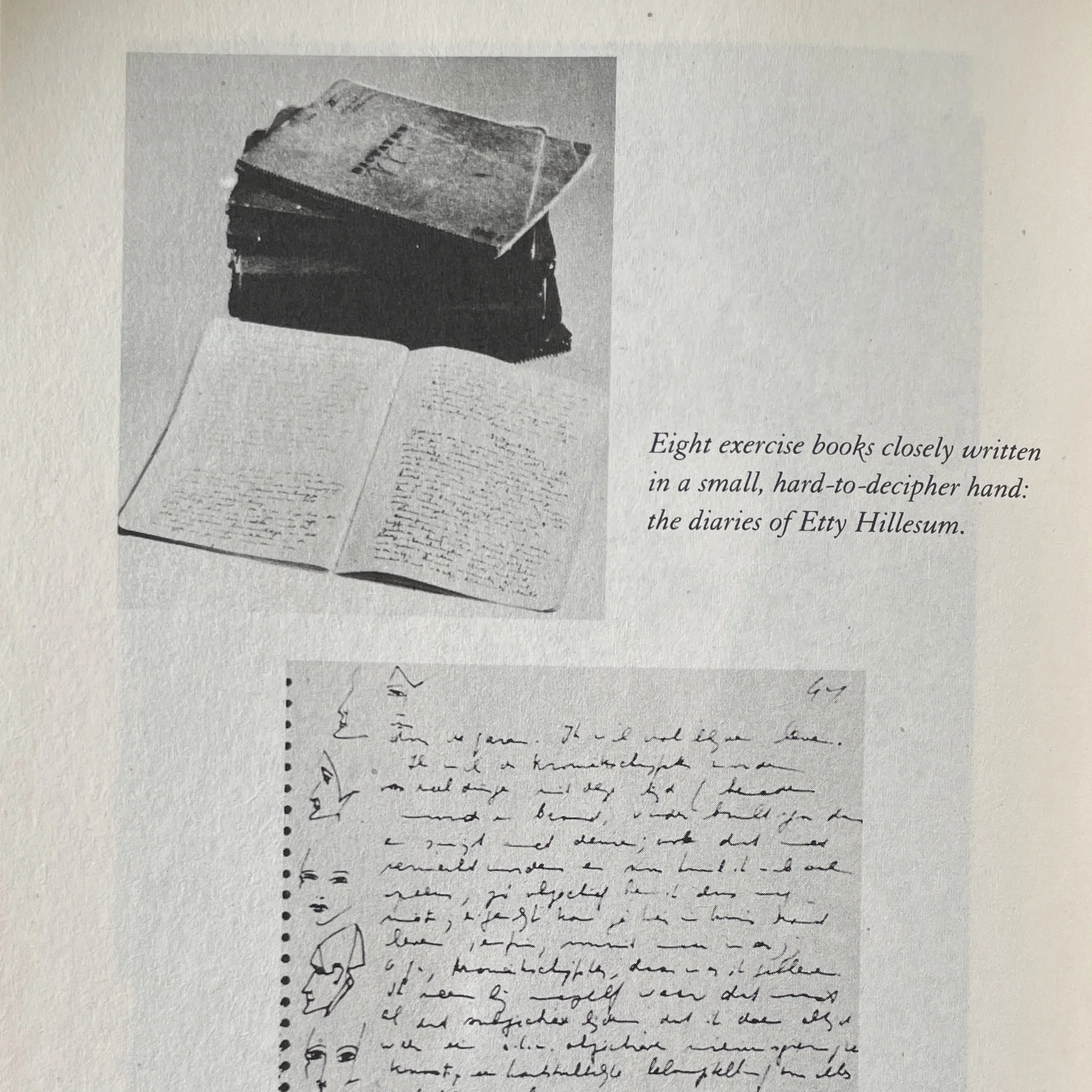
Eight exercise books closely written in a small, hard-to-decipher hand: the diaries of Etty Hillesum
I underline, I annotate, I scribble on the sides, I wait. I leave a trace, a piece of myself on the page. Later, I make a list:
room
pebble
knees
scratched stars
poem
then, almost as if she were answering me, Etty writes: ‘There is no hidden poet in me, just a little piece of God that might grow into poetry.’ [4]
ii.
I open the window. Autumn is about to begin. The air is fresh, soft, cold. The sky is clear. A single star hangs there—lonely, solitary, melancholy. At night, words grow louder. Creatures rise from my thoughts. I keep looking at the sky, my desk only a few steps away. The room is almost a sanctuary.
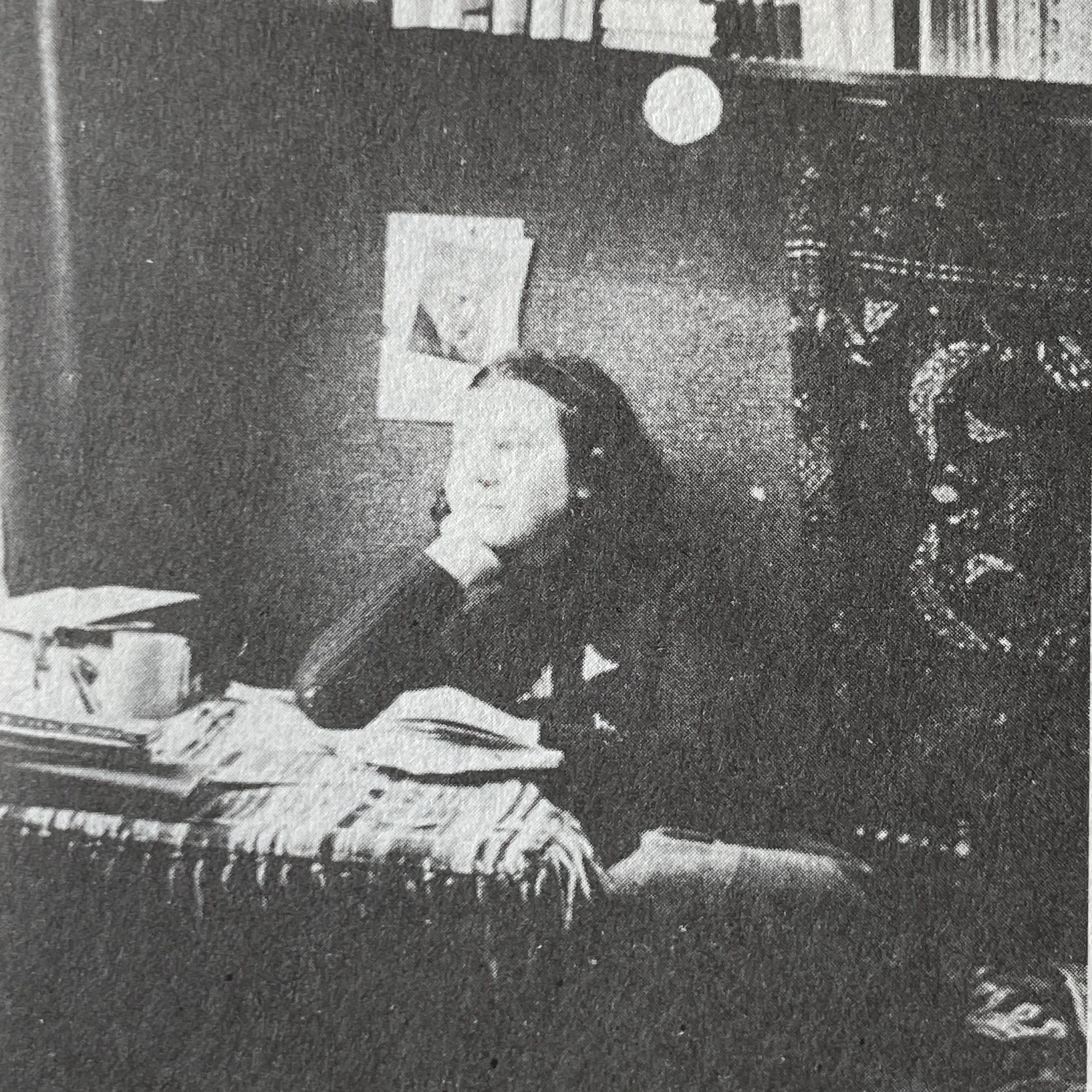
Etty at her desk, by the window, in her home in Amsterdam.
Did Etty know? A short life, a world that does not ask for permission. Did she write for herself? Did she write for us?
Her diary is open. Her letters have been read many times. I make a map of Amsterdam, an attempt to understand. What did Etty do? Where did she go? What time of the day she wrote? What did she dream? Could you dream in the summer of 1941 as a young Jewish woman?
I collect words, moods, an expression on her face, a line of hope here and there. ‘I would love to be like the lilies of the field’ [5]
iii.
I step away from the window. My body feels heavy, my eyes tired. It is deep and dark outside. On the desk a lamp lights a single page. I select a word, transcribe it in my notebook. A notebook is a village, it seams together I’s. Dangerous longings.
Dense secrets are revealed, or so I think. I don’t read, I am just here, one word, many meanings. Does the night control us? The moon, where is she? What was the last thing Etty saw? A naked body, beauty, terror or perhaps hope? I want to write a poem for Etty, a poem of home, love, peace.
iv.
I make another list. This time of her favorite writers:
Rainer Maria Rilke
Fyoder Dostoevsky
Of Rilke, Etty writes: “Take Rilke. A single line is suddenly more important to me than—well, than what? I’ve been living on a few lines from his book on Rodin for months now.” [6].
With Dostoevsky, Etty is visceral. The body responds. It becomes animal, intent on grasping everything. And then we read: ‘I still remember reading him — was it during Christmas vacation? — at home. Until I was dazed, exhausted and stupefied, hundred of thousands of pages on end. And now, just a few pages. Every so often, although these few I then actively recreate, carrying them about with me everywhere for days.’[7]
A few lines later, she returns to the Russian writer. Etty loved Dostoevsky for his ability to enter the most wretched and contradictory regions of human nature without passing final judgment on them. Her diary makes this clear: ‘… Dostoevsky has been pursuing me of late, striking home time after time. I suddenly came across a short quotation from Dostoevsky with which I shall end for today: [8]
“It is wrong to judge people as you do. There is no love in you, only strict justice; that makes you unjust”.
But Etty always returns to Rilke. To his poems, to his lines, which continue to speak to her even amid the violence of the present. On the final page of the diary, reflecting on poetry’s power to nourish the inner life, she writes:
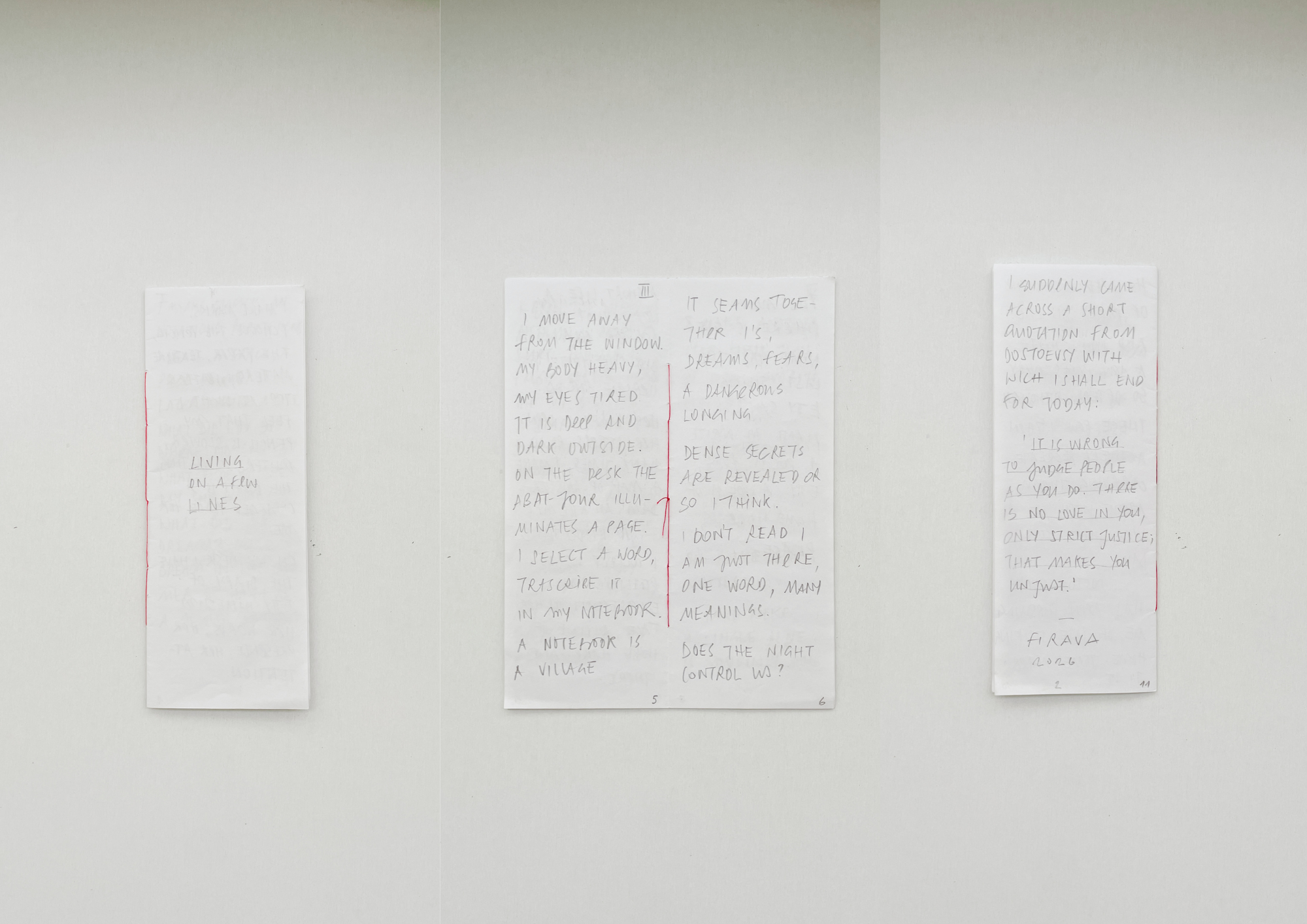
Pages from my handwritten essay. Pencil, paper, red thread. A way of bringing Etty’s words into the texture of my own experience—not only reading her, but writing, touching, and sewing the pages by hand.
[1] From ‘An Interrupted Life and Letters from Westerbork’, Henry Holt and Company, p. 287
[2] Ibid. p. 55
[3] Ibid. p. 192
[4] Ibid. p. 225
[5] Ibid. p. 209
[6] 12 December 1941
[7] Ibid.
[8] Ibid.
[9] Ibid. p. 231
First published in anArchive an ever-evolving archive of essays, notes, fragments, and insights. Italian translation here.